
The challenge
Multicriteria Mapping was originally developed in the late 1990s as a structured methodology for navigating complex decisions involving uncertainty, competing priorities and diverse stakeholder perspectives.
The framework had been successfully applied across energy strategy, environmental policy, public health, food production, radioactive waste management and more. However, its impact was constrained by the absence of a scalable digital platform.
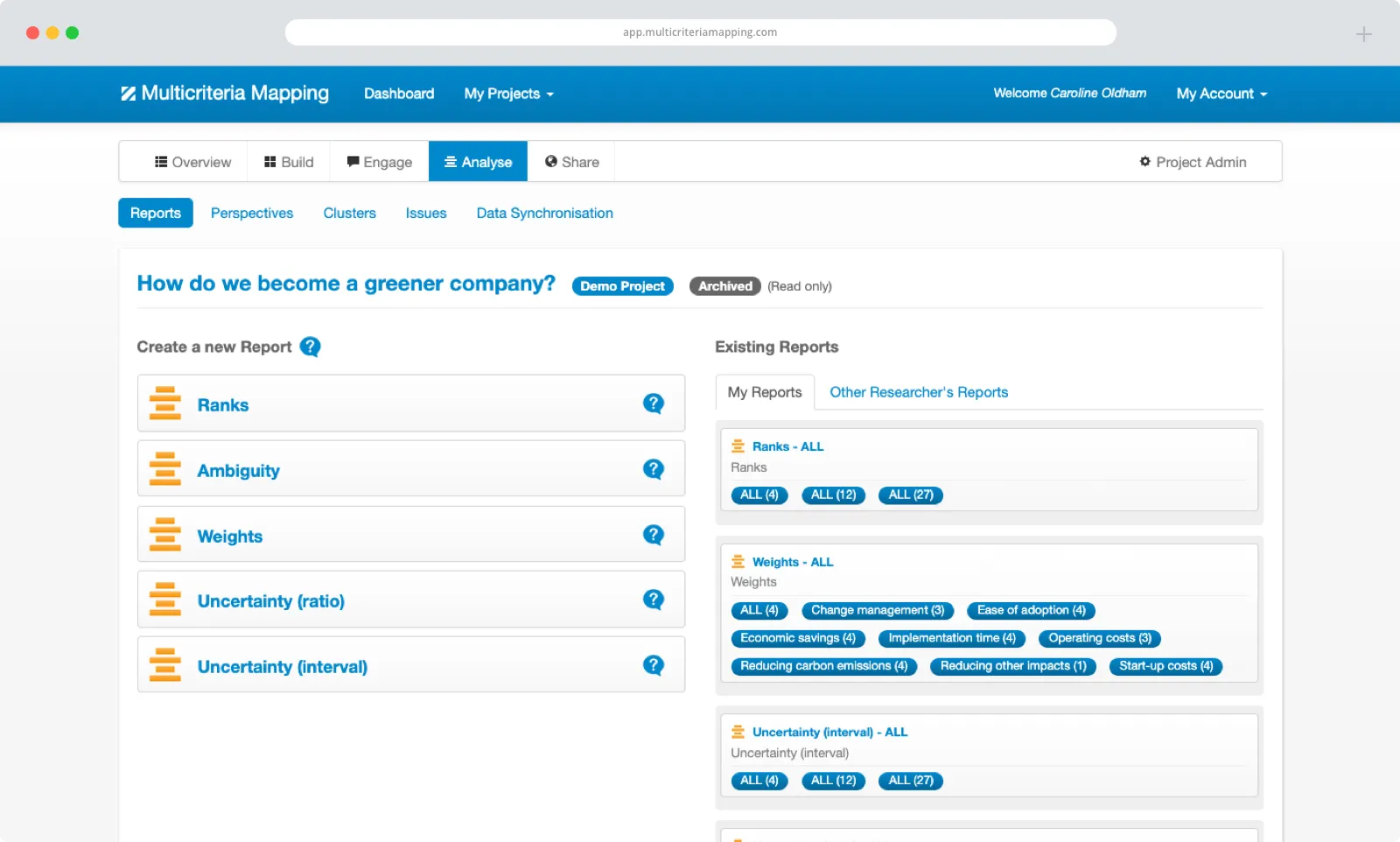
The challenge was to translate a nuanced academic methodology into an accessible, collaborative product capable of supporting real-time analysis, structured workshops and use in remote areas with limited internet connectivity.
This required technical execution alongside a deep understanding of the underlying theory.
Our approach
We worked closely with Professor Stirling and the university project team to fully understand the MCM methodology before writing a single line of code.
Through one-to-one interviews with existing users, we analysed how the tool was applied in practice. This informed the development of a working prototype, allowing us to test and refine the user experience before the full build.
The final system was developed using Python and Django, supported by a MySQL database. Rich user interactions were implemented using JavaScript with BackboneJS and jQuery UI.
To support access in challenging environments, we also developed a desktop application using Node-Webkit, enabling offline data capture with a custom synchronisation backend. This made the tool suitable for field research and remote workshops worldwide.
Throughout, our focus was on preserving methodological integrity while increasing usability and scalability.
I just wanted to say thank you again to DabApps for doing such a great job!
Prof Andrew Stirling, Professor of Science & Technology Policy, SPRU, University of Sussex
Results and impact
Multicriteria Mapping is now available as a commercial product and has been used to support numerous projects, conferences and policy workshops.
The platform enables structured exploration of alternative options in complex decisions, helping organisations surface uncertainty, clarify assumptions and incorporate multiple perspectives transparently.
By digitising and scaling the methodology, we extended its reach beyond academic settings into government, voluntary and commercial sectors.
What began as a research framework is now a reliable digital tool supporting informed, transparent decision-making across disciplines.
Looking ahead
As complex decision-making becomes increasingly central to policy, sustainability and strategic planning, tools like MCM provide structured clarity in uncertain environments.
The platform's flexible architecture ensures it can continue evolving to meet new research and policy demands, supporting collaboration across sectors and geographies.