The challenge
The previous DabApps website had served us well, but the business had moved on.
AI was becoming a much bigger part of our client work. However, those conversations rarely begin with the technology. They begin with understanding how an organisation works, what people are trying to achieve, where friction exists and which systems and data are involved.
The site needed to communicate that clearly without losing sight of the work DabApps was already known for: complex web applications, mobile products, APIs, operational platforms and long-term software support.
It also needed to work harder commercially. Senior buyers should be able to understand quickly what we do, why our experience matters and whether we are the right partner for a substantial digital product or transformation programme.
Our approach
We treated the redesign as a product and positioning challenge before treating it as a visual design project.
The first task was to simplify the story. Rather than presenting a long list of capabilities, we organised the site around the way successful software is shaped: understanding the opportunity, designing the product, building the technology and supporting it as it evolves.
This created a clearer role for every part of the site. Service pages explain how we help. Sector pages connect that expertise to specific business challenges. Case studies provide evidence.
The case-study library was designed as a commercial tool rather than a complete archive. Visitors can explore relevant work through simple filters, while featured projects can change to support current campaigns and strategic priorities.
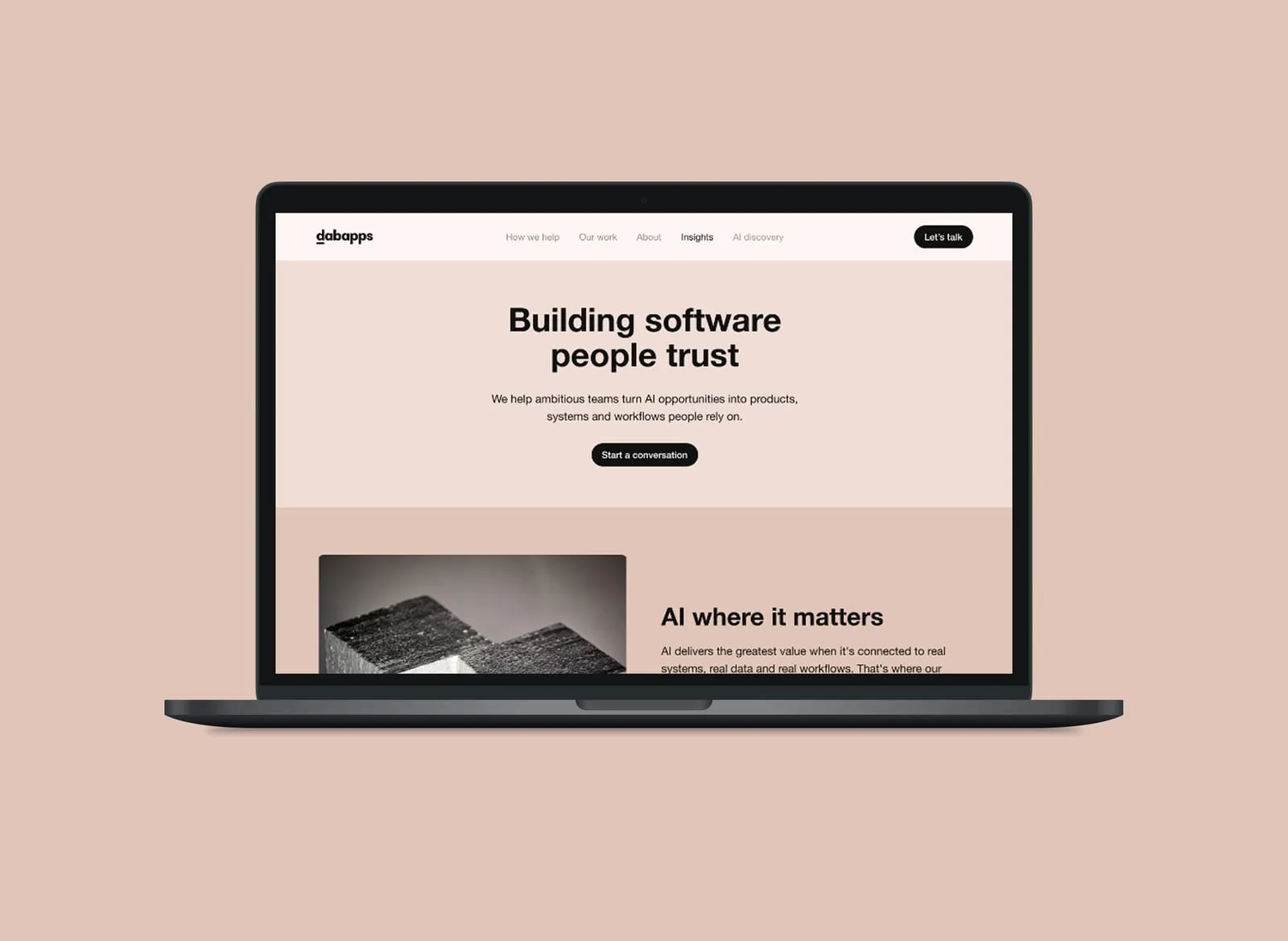
Visually, the aim was clarity and confidence. The site needed to feel calm, mature and easy to scan, while providing enough depth for people evaluating a serious product or engineering partner.
Redesigning the DabApps website gave us the opportunity to apply the same thinking we bring to client work. We started by asking what the site really needed to do, then used Astro to give it a fast, structured and maintainable foundation. That is where the craft sits for me: making something feel simple because the thinking underneath is properly joined up.
Mark Aaron Creative Director, DabApps
The technical approach
The build followed the same principle as the design: use the right level of technology for the problem.
Astro provided a fast, static foundation for a content-led website, with structured content collections and reusable page patterns but without unnecessary backend complexity.
Case studies, insights, services, sectors, team profiles and featured content are all managed through consistent data models. This makes the site easier to maintain and gives the content room to evolve without rebuilding the underlying system.
The migration also required careful handling. Existing service pages, articles, case studies and legacy routes were mapped through redirects to protect the value of the previous site and avoid breaking established links.
Astro's image pipeline supports efficient asset handling, while page-level metadata, social sharing images, sitemaps, robots directives and structured descriptions provide the foundations for search visibility.
Nothing was added for its own sake. The aim was to make the experience feel simple because the content, routing, imagery and technical architecture had been properly considered.
The outcome
The new website gives DabApps a clearer platform for the work we do now.
It positions practical AI transformation alongside the product design and software engineering required to make it useful. It also gives greater prominence to the complex platforms, mobile products and long-term partnerships that demonstrate our technical depth.
The site is now better equipped to support marketing and business development. Case studies can anchor campaigns. Sector pages can address the priorities of different audiences. Service content can evolve independently. Insights can connect our thinking directly to relevant work.
Most importantly, the website reflects the approach we bring to client projects: understand the problem, the people, the systems and the data before deciding what to build.