
The challenge
Take Me to the Moon creates highly personalised journeys through Bali and wider Indonesia, combining detailed local knowledge with carefully selected experiences and practical support.
Its customers are not simply buying an itinerary. They are buying confidence that their time will be used well, access to recommendations shaped by real experience and reassurance that knowledgeable support is available when needed.
Delivering that level of service takes time. Each journey must be carefully understood, researched and shaped around the traveller.
At the same time, tools such as ChatGPT have made basic itinerary generation widely accessible. Take Me to the Moon initially approached us to explore whether it should create an AI-powered journey builder of its own.
The challenge was to identify where technology could add genuine value without turning a distinctive, expert-led service into something generic.
Our approach
We began by looking beyond the initial feature idea and examining the complete customer experience.
Through stakeholder interviews, prototype testing and a collaborative workshop, we explored what customers genuinely valued and where the service made the greatest difference.
We reviewed real consultations, traveller briefs, proposals and itineraries. These revealed a wide range of needs, from families balancing activities around young children to independent travellers looking for authentic experiences without feeling unsupported.
Across these journeys, one pattern remained consistent. The itinerary mattered, but its real value came from the judgement behind it: understanding pace, logistics, preferences and what works in practice.
That insight changed the direction of the project.
Rather than designing another general-purpose itinerary generator, we developed a product vision in which AI and digital tools strengthen the team's expertise.
Turning the itinerary into a living experience
The existing itinerary contained valuable information, but was delivered primarily as a static document. Once travellers were moving between locations and responding to changes, it became harder to use.
We repositioned it as the centre of a connected digital experience.
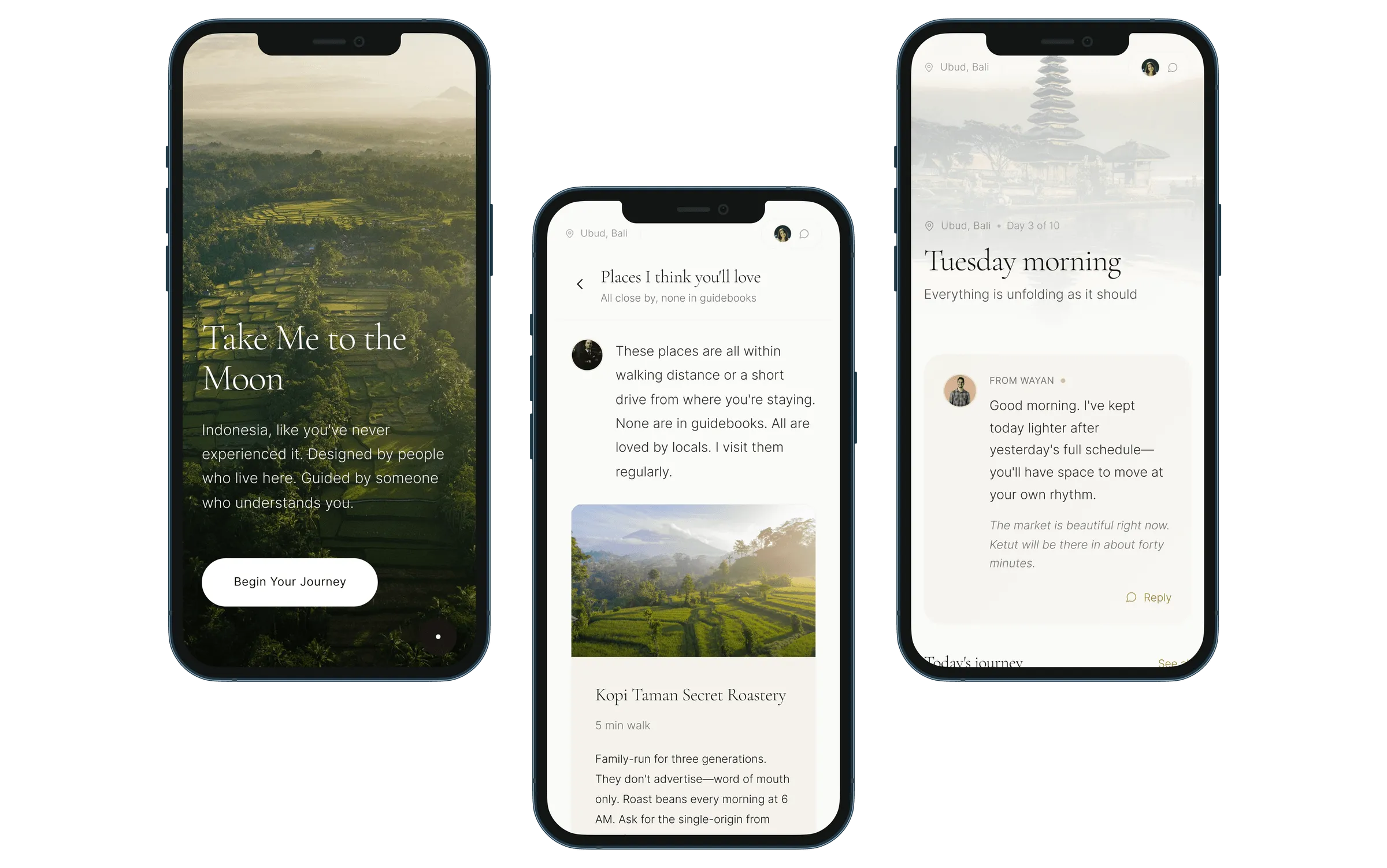
The proposed mobile companion brings each day of the journey together in one place, including accommodation, activities, transfers, maps and practical information.
Relevant guidance could appear at the right moment, while updates could be reflected directly within the itinerary rather than being scattered across separate messages and replacement documents.
Our research also showed that support during travel was part of the emotional value of the service. Travellers wanted to feel independent, but not abandoned.
The companion was therefore designed to provide calm, contextual support, with timely information, lightweight check-ins and clear routes to human help when needed.
AI could help organise feedback, surface useful information and identify situations that may require attention. Its role would not be to imitate the concierge relationship, but to help the real relationship remain effective as the service grows.
Supporting expert work
We also explored how technology could reduce repetitive work behind the scenes.
Information gathered during customer conversations could be organised more consistently, helping the team identify important preferences and constraints. AI could assist by structuring this information and preparing initial working material for review.
The team would remain responsible for understanding the traveller, shaping the journey and approving every recommendation.
This created a practical role for AI: supporting expert work rather than attempting to replace it.
The outcome
What began as an exploration of an AI journey builder became a broader vision for a connected travel experience built around Take Me to the Moon's strongest differentiator: thoughtful, human-led travel design supported by deep local knowledge.
The discovery established:
- A clearer definition of the value customers receive
- A mapped journey from initial planning through to support during travel
- A prototype for a dynamic mobile travel companion
- A defined role for AI across planning and contextual support
- A high-level technical direction and phased scope for development
The resulting concept gives the team better tools, creates a richer experience for travellers and provides a foundation for growth without losing the personal character of the service.
For Take Me to the Moon, the opportunity is not simply to generate itineraries more quickly. It is to turn each itinerary into a living connection between the traveller, the destination and the people supporting their journey.