
The challenge
Many businesses operate reactively, reviewing financial performance after the fact rather than using forecasting as a live control mechanism. That limits their ability to manage cashflow, respond to risk early and move quickly when growth opportunities appear.
Futrli set out to disrupt traditional financial reporting with a forward-looking platform that helps businesses course-correct in real time. To do that, the team needed a development partner who could combine strategic product thinking with scalable technical execution in a fast-moving fintech market.
Our approach
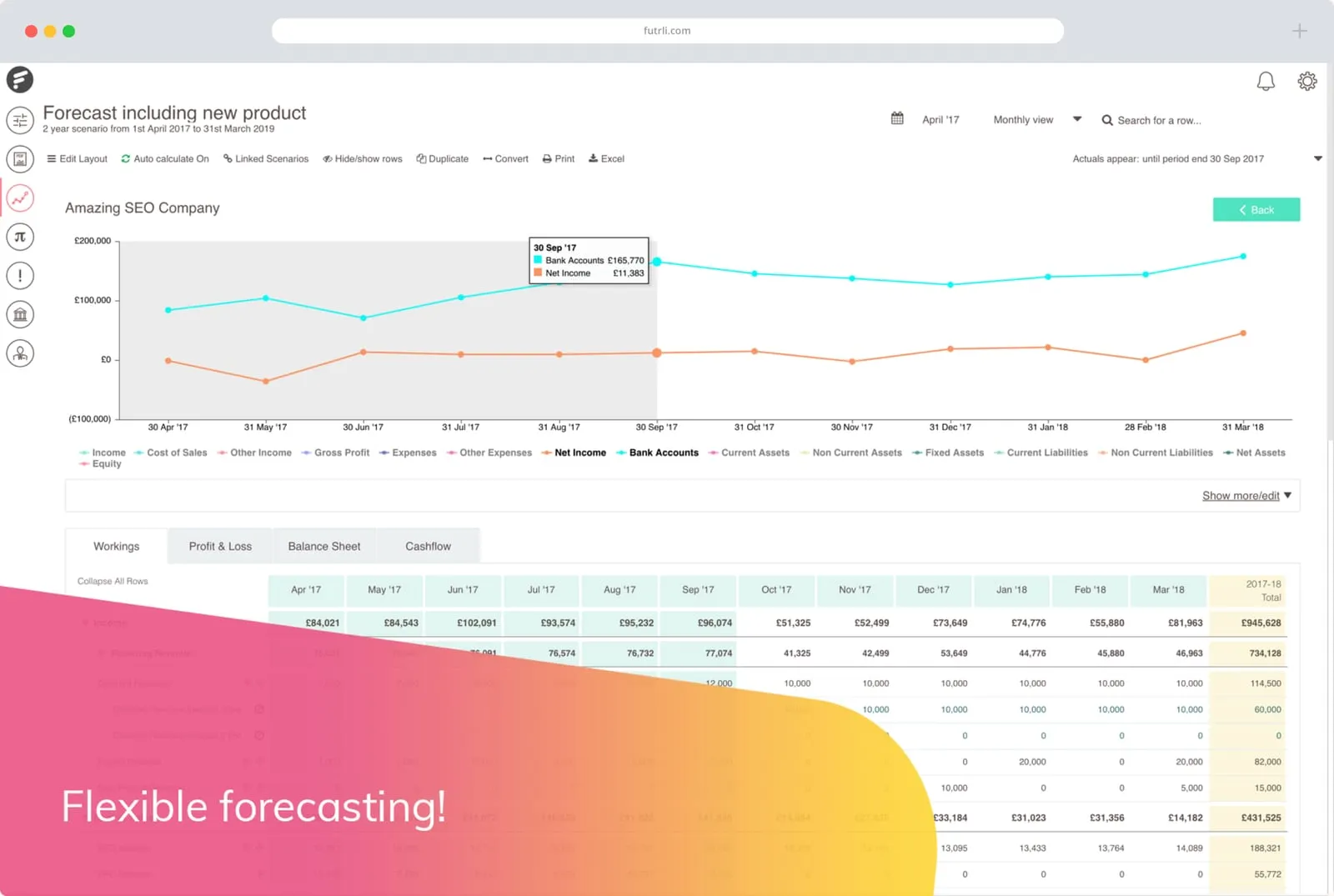
From the outset, we worked closely with Futrli's founding team, contributing to product vision as well as technical delivery. Through collaborative discovery and design workshops, we helped shape the distinctive concept of boards: a visual framework for turning complex finance data into clear, usable insight.
Behind the interface, we supported the development of scalable product foundations capable of handling growing user numbers and increasingly sophisticated forecasting features. Working in a shared agile rhythm, we helped Futrli accelerate product maturity and respond to market demand.
DabApps doesn't feel like it's an external team.
Hannah McIntyre, Co-Founder of FUTRLI
Results and impact
Since launching in 2015, Futrli has grown into a globally recognised financial intelligence platform with customers in more than 100 countries.
Businesses using the platform can move from retrospective reporting to proactive financial management. Clearer forecasting supports stronger cashflow control, earlier identification of risk and better-informed investment decisions. The intuitive boards experience became a key differentiator, helping drive adoption and retention in a competitive fintech landscape.
Looking ahead
As financial intelligence becomes increasingly predictive and data-driven, Futrli is well positioned to deliver even greater commercial impact.
Our early-stage partnership helped establish the product foundations that enabled global scale. It is a strong example of how product strategy, UX and web application development need to work together when software has to grow beyond its first market.